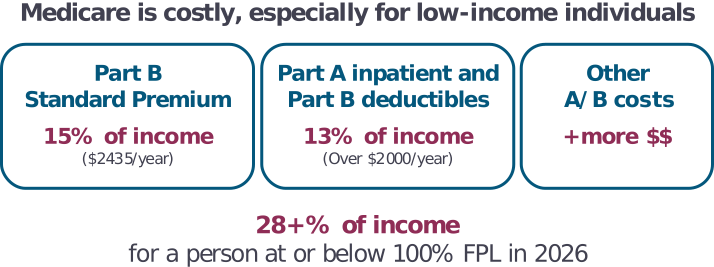
1 Out-of-pocket health care spending costs Medicare beneficiaries on average $6,330 per capita in 2022, accounting for 39% of annual Social Security income. Nancy Ochieng et al., “Health Costs Consume a Large Portion of Income for Millions of People with Medicare,” KFF, August 21, 2025, https://www.kff.org/medicare/health-costs-consume-a-large-portion-of-income-for-millions-of-people-with-medicare.
2 In 2026, the federal poverty level is $1,330 per month. The Part B premium of $202.90 is over 15% of that amount. See U.S. Department of Health and Human Services, Office of the Assistant Secretary for Planning and Evaluation, “2026 Poverty Guidelines: 48 Contiguous States (All States except Alaska and Hawaii),” 2026, https://aspe.hhs.gov/sites/default/files/documents/b1bfa16b20ae9b89d525bc35de7c1643/detailed-guidelines-2026.pdf; Centers for Medicare & Medicaid Services (CMS), “2026 Medicare Parts A & B Premiums and Deductibles,” Nov. 14, 2025, https://www.cms.gov/newsroom/fact-sheets/2026-medicare-parts-b-premiums-deductibles; Medicare.gov. “Costs | Medicare.” https://www.medicare.gov/basics/costs/medicare-costs.
3 Susan L. Hayes et al., “Moving from Medicaid Expansion Coverage to Medicare Can Be a Burdensome Transition: A Qualitative Study,” Table 4, Journal of General Internal Medicine, September 2, 2025, https://doi.org/10.1007/s11606-025-09789-9. See also, for example, “‘Yingtong’ #06,” The People Say, 2023, https://thepeoplesay.org/data/show/Yingtong-06; “‘Gretchen’ #05,” The People Say, 2025, https://thepeoplesay.org/data/show/Gretchen-05; Susan Silberman et al., Standing Back from the Medicare Cliff: Research and Policy Options to Help Low-Income Older Adults (National Council on Aging and LeadingAge LTSS Center @UMass Boston, 2024), Valerie’s responses in Appendix C-1, https://assets.ncoa.org/ffacfe7d-10b6-0083-2632-604077fd4eca/467f43a0-d595-483b-8fdb-be068ab9cbbf/2024_Medicare_Cliff_Report.pdf.
4 Juliette Cubanski, et al., “Overall Satisfaction with Medicare is High, But Beneficiaries Under Age 65 With Disabilities Experience More Insurance Problems Than Older Beneficiaries,” KFF, October 26, 2023, https://www.kff.org/medicare/overall-satisfaction-with-medicare-is-high-but-beneficiaries-under-age-65-with-disabilities-experience-more-insurance-problems-than-older-beneficiaries.
5 Part D Extra Help is also sometimes referred to as the low-income subsidy, or LIS. For more information on Extra Help, see https://www.medicare.gov/basics/costs/help/drug-costs.
6 States must use income and asset methodologies for MSP eligibility that are no more restrictive than those applied in the supplemental security income (SSI) program. Under section 1902(r)(2) of the Social Security Act, some states have adopted methodologies less restrictive than SSI, effectively raising income and asset limits above the federal baseline and, in some instances, removing the asset test altogether. See Centers for Medicare & Medicaid Services (CMS), “Chapter 1: Program Overview and Policy,” Manual for the State Payment of Medicare Premiums, Pub. 100-24, section 1.6.2.1, https://www.cms.gov/files/document/chapter-1-program-overview-and-policy.pdf; Medicare Payment Advisory Commission (MedPAC) and Medicaid and CHIP Payment and Access Commission (MACPAC), “Data Book: Beneficiaries Dually Eligible for Medicare and Medicaid,” Table 2, December 2025, https://www.macpac.gov/wp-content/uploads/2025/12/Dec25_MedPAC_MACPAC_DualsDataBook-WEB508-FINAL.pdf.
7 In 2026, Part B premium coverage totals almost $2,436 annually. The Part D LIS benefit is estimated to be worth about $5,700 per year. Social Security Administration, “Understanding the Extra Help With Your Medicare Prescription Drug Plan,” January 2026, https://www.ssa.gov/pubs/EN-05-10508.pdf.
8 Alex D. Federman et al., “Avoidance Of Health Care Services Because Of Cost: Impact Of The Medicare Savings Program,” Health Affairs 24, no. 1 (2005): 263-70, https://doi.org/10.1377/hlthaff.24.1.263; Eric T. Roberts et al., “Racial and Ethnic Disparities in Health Care Use and Access Associated With Loss of Medicaid Supplemental Insurance Eligibility Above the Federal Poverty Level,” JAMA Internal Medicine 183, no. 6 (2023): 534-43, https://doi.org/10.1001/jamainternmed.2023.0512.
9 Eric T. Roberts et al., “Loss of Subsidized Drug Coverage and Mortality among Medicare Beneficiaries,” New England Journal of Medicine 392, no. 20 (2025): 2025-34, https://doi.org/10.1056/NEJMsa2414435.
10 Sarah Kotb et al., “Medicare Savings Program Take-Up Estimates and Profile of Enrolled and Unenrolled Individuals,” JAMA Network Open 8, no. 10 (2025): e2535408–e2535408, https://doi.org/10.1001/jamanetworkopen.2025.35408; Kyle J. Caswell and Timothy A. Waidmann, “Medicare Savings Programs: New Estimates Continue to Show Many Eligible Individuals Not Enrolled,” MACPAC, June 15, 2017, https://www.macpac.gov/publication/medicare-savings-programs-new-estimates-continue-to-show-many-eligible-individuals-not-enrolled; Matthew Niedzwiecki et al., “Medicare Savings Programs: Findings on Eligibility and Enrollment Trends Final Report,” Office of the Assistant Secretary for Planning and Evaluation, January 10, 2025, https://aspe.hhs.gov/sites/default/files/documents/f9311ce78b51111648aa10aca69c953c/medicare-savings-programs-final-report.pdf.
11 CMS Office of Burden Reduction & Health Informatics, “Navigating the Medicare Savings Program (MSP) Eligibility Experience,” n.d., https://www.cms.gov/files/document/navigatingmedicare-savings-program-msp-eligibilityexperience-journey-map.pdf; U.S. Department of Health and Human Services, Office of the Assistant Secretary for Planning and Evaluation, Loss of Medicare-Medicaid Dual Eligible Status: Frequency, Contributing Factors, and Implications, May 8, 2019, https://aspe.hhs.gov/basic-report/loss-medicare-medicaid-dual-eligible-status-frequency-contributing-factors-and-implications; Medicaid and CHIP Payment and Access Commission (MACPAC). “Improving participation in the Medicare Savings Programs,” Report to Congress, June 2020, https://www.macpac.gov/publication/chapter-3-improving-participation-in-the-medicare-savings-programs; Government Accountability Office, “Medicare Savings Programs: Implementation of Requirements Aimed at Increasing Enrollment,” September 2012, https://www.gao.gov/assets/gao-12-871.pdf.
12 These model policies do not apply to the U.S. territories because they have not adopted the MSPs, which are mandatory Medicaid eligibility groups for the 50 states and the District of Columbia but optional for the territories. See CMS, Working Families ‘Tax Cut’ Legislation, Public Law 119-21: Summary of Medicaid and Children’s Health Insurance Program (CHIP) Related Provisions, CMCS Informational Bulletin, November 18, 2025, 4, https://www.medicaid.gov/federal-policy-guidance/downloads/cib11182025.pdf.
13 Applicable to the continental U.S. Separate income limits for Alaska and Hawaii are available at Medicaid.gov. “Seniors & Medicare and Medicaid Enrollees | Medicaid.” 2026. https://www.medicaid.gov/medicaid/eligibility-policy/seniors-medicare-and-medicaid-enrollees. Medicare Savings Program income limits are codified at 42 CFR 435.121 to 435.125. The monthly income levels include a standard $20 income disregard.
14 States receive federal financial participation (FFP) at their standard Federal Medical Assistance Percentage (FMAP) rate for the state payment of Medicare Part A and B premiums and cost sharing for QMBs and Part B premiums for SLMBs. The federal government fully funds the payment of the Part B premiums for QIs through annual allotments to states. The standard FMAP rate varies based on a state’s average per capita income, ranging from 50% to 77% in federal fiscal year 2026. See CMS, Manual for the State Payment of Medicare Premiums, chapter 1, section 1.9; Elizabeth Williams et al., “Medicaid Financing: The Basics,” KFF, March 4, 2026, https://www.kff.org/medicaid/medicaid-financing-the-basics.
15 The Qualified Disabled & Working Individuals (QDWI) MSP group is an extremely small MSP category limited to low-income individuals under 65 with disabilities who enroll in premium Part A about eight and a half years after returning to work, once their premium-free Part A ends. As of March 2025, only about 150 QDWIs were enrolled nationwide—mostly in single digits per state. Enrollment is low because QDWIs must be ineligible for all other Medicaid eligibility groups. Many individuals with disabilities who return to work qualify for full-benefit Medicaid (e.g., Medicaid eligibility groups first enacted in The Ticket to Work and Work Incentives Improvement Act of 1999), making them ineligible for QDWI. Others who meet QDWI income requirements may choose not to enroll in premium Part A with QDWI if available employer or marketplace plans are more affordable. CMS, Manual for the State Payment of Medicare Premiums, chapter 1, sections 1.3.2, 1.6.2; “MMCO Statistical & Analytic Reports | CMS,” March 4, 2026, https://www.cms.gov/data-research/research/statistical-resources-dually-eligible-beneficiaries/mmco-statistical-analytic-reports.