
| Problem | Enrolling in Medicare results in many people losing Medicaid and facing much higher out-of-pocket costs. These costs amount to a financial shock—a problem known as the “Medicare cliff.” |
| Solution |
|
| Benefits for older adults and people with disabilities |
|
| Benefits for states | Maximize federal funding. |
| State cost implications | Increased Medicaid spending to cover Medicare cost sharing for people with incomes up to 138%. |
Open for Public Comment
We are seeking comments on these new model policies and look forward to feedback to improve our work. Please submit your comments by 07/10/2026 via this feedback form. If you run into accessibility issues or want to email us your comments, contact us at info@ADHealthPolicyLab.org.
Simplifying Access to the Medicare Savings Programs
State Model Policy
Flatten the Benefit Cliff from Medicaid to Medicare
Summary
Medicaid generally requires minimal (if any) premiums or other cost sharing from the people enrolled in the program. In contrast, Medicare has monthly premiums, annual deductibles, and other significant cost sharing. In most states, a large number of people lose Medicaid when their Medicare starts. For affected individuals, the higher costs in Medicare amount to a financial shock—a problem known as the “Medicare cliff.”
As one interviewee put it after experiencing the Medicare cliff:
“When I hit whatever magic age it was, when I could collect Medicare, they pulled the rug out from under me.”49
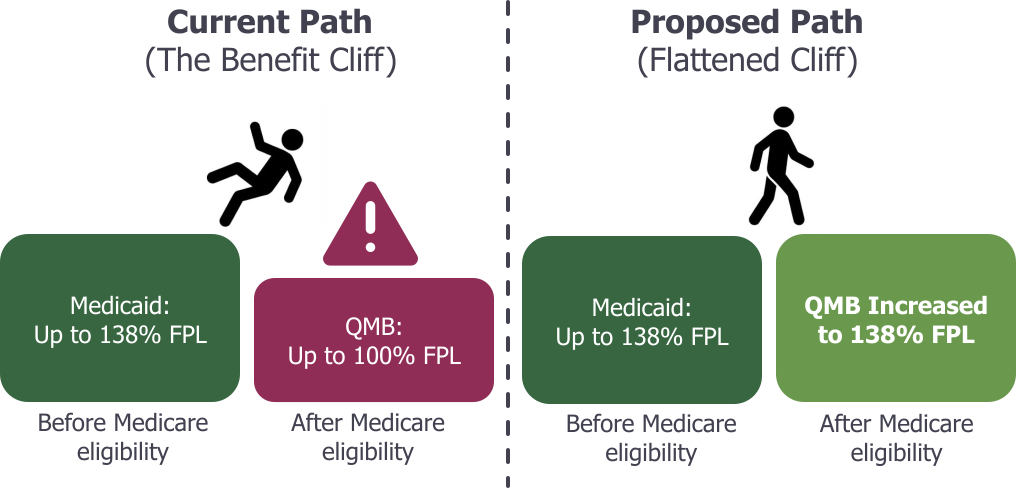
The Medicare Savings Programs (MSPs) cover certain Medicare costs for people with low income. Medicare beneficiaries with incomes at or below 100% of the federal poverty level (FPL) qualify for coverage of Medicare Parts A and B premiums and cost sharing through the Qualified Medicare Beneficiary (QMB) category. But, in most states, Medicaid covers adults with incomes up to 138% of the federal poverty level before they qualify for Medicare. Therefore, one source of the Medicare cliff is a misalignment between the QMB category (up to 100% of the federal poverty level) and other Medicaid eligibility groups (up to 138%).
The model state legislation below, using flexibilities already available to state Medicaid agencies,50 would:
- Flatten the Medicare cliff by covering Part A and B premiums and cost sharing through the QMB category for Medicare beneficiaries with incomes up to 138% of the federal poverty level,
- Cover Part B premiums through the fully federally funded Qualifying Individual (QI) category for Medicare beneficiaries with income between 138% and 186% of the federal poverty level, and
- Simplify the MSPs by eliminating the Specified Low-Income Beneficiary Program (SLMB) category, because SLMB would be fully encompassed in the expanded QMB group.
This model policy does not include the Qualified Disabled Working Individuals (QDWI) category because the flexibilities that allow states to make changes to QMB, SLMB, and QI categories do not apply to QDWI.
States must obtain federal approval for this policy, but the process is routine. It just requires a standard amendment to their State Medicaid Plan.
Where this model policy could apply:
One state (New York51) has established MSP criteria consistent with this model policy already. Five other states (Connecticut52, Indiana53, Maine54, Massachusetts55 and Vermont56) and the District of Columbia57 already use more generous criteria than this model policy.
Therefore, this model policy only improves access to the MSPs in the remaining states.
History for this model policy:
First published: 05/11/2026 (draft)
Modified: N/A
49 Susan L. Hayes et al., “Moving from Medicaid Expansion Coverage to Medicare Can Be a Burdensome Transition: A Qualitative Study,” Journal of General Internal Medicine, September 2, 2025, https://doi.org/10.1007/s11606-025-09789-9.
50 SSI income methodologies are used to determine income eligibility for the MSPs, but states can apply less restrictive resources under section 1902(r)(2) of the Social Security Act. See Centers for Medicare & Medicaid Services (CMS), “Implementation Guide: Medicaid State Plan Eligibility. Eligibility Groups – Mandatory Coverage Qualified Medicare Beneficiaries,” Medicaid.gov, n.d., https://www.medicaid.gov/resources-for-states/downloads/macpro-ig-qualified-medicare-beneficiaries.pdf; CMS, “Implementation Guide: Medicaid State Plan Eligibility. Eligibility Groups – Mandatory Coverage Qualifying Individuals,” Medicaid.gov, n.d., https://www.medicaid.gov/resources-for-states/downloads/macpro-ig-qualifying-individuals.pdf.
51 New York has increased QMB to 138% and QI to 186% and eliminated SLMB. Sbrana, Lisa. “Changes to Medicare Savings Program (MSP) Income Levels.” Office of Health Insurance Programs, December 5, 2022. https://www.health.ny.gov/health_care/medicaid/publications/docs/gis/22ma10.pdf.
52 Connecticut has increased QMB to 211%, SLMB to 231%, and QI to 246%. Conn. Gen. Stat. § 17b-256f (2024).
53 Indiana has increased QMB to 150%, SLMB to 170%, and QI to 185%. Indiana Family and Social Services Administration, Indiana Health Coverage Program Policy Manual, section 1610.45.10, https://www.in.gov/fssa/ompp/files/Medicaid_PM_1600.pdf.
54 Maine has increased QMB to 185% and QI to 250% and eliminated SLMB. 10 ME Code Rules § 144-332-8-4.
55 Massachusetts has increased QMB to 190%, SLMB to 210%, and QI to 225%. Rossi, Heather. “Medicare Savings (Buy-in) Programs.” Commonwealth of Massachusetts, Office of Medicaid, February 2023. https://www.mass.gov/doc/eom-23-04-medicare-savings-buy-in-programs-0/download.
56 Vermont has increased QMB to 150% and QI to 202% and eliminated SLMB. Agency of Human Services, Department of Vermont Health Access. “Medicare Savings Program.” 2026. https://dvha.vermont.gov/members/medicare-savings-program.
57 The District of Columbia has increased QMB to 300% and eliminated SLMB and QI. “Qualified Medicare Beneficiaries.” Government of the District of Columbia, Department of Health Care Finance, December 1, 2014. https://dhcf.dc.gov/sites/default/files/dc/sites/dhcf/publication/attachments/QMB_Policy.pdf.
Model Legislative Text
WHEREAS [state residents] moving from Medicaid to Medicare often can face higher costs in the form of Medicare premiums and cost sharing.
WHEREAS Medicare beneficiaries may qualify for Medicaid coverage of these costs through the Qualified Medicare Beneficiary eligibility group.
WHEREAS Medicare beneficiaries who lose Medicaid struggle with health care costs and may delay or skip the care they need, taking a toll on their health and financial security.
WHEREAS other states have expanded eligibility for Qualified Medicare Beneficiaries to 138% of the federal poverty level or higher.
BE IT ENACTED that:
[Agency or agency head] shall seek approval from the Centers for Medicare & Medicaid Services as necessary to, effective no later than [date]:
- Eliminate Medicare cost-sharing obligations for additional [state residents] by disregarding, for the Qualified Medicare Beneficiary (QMB) group, countable income equal to 38% of the maximum federal income standard for that group (100% of the federal poverty level), thereby effectively increasing the QMB eligibility group income limit to 138% of the federal poverty level and eliminating the need for enrollment in the Specified Low-Income Beneficiary (SLMB) eligibility group, and
- Extend Part B premium coverage for additional [state residents] by disregarding, for the Qualifying Individual (QI) group, countable income equal to 38% of the maximum federal income standard for that group (135% of the federal poverty level), thereby effectively increasing the income range for the QI eligibility group to between 138% to 186% of the federal poverty level.
To the extent permitted by the Centers for Medicare & Medicaid Services, on the effective date of federal approval, [agency or agency head] shall automatically enroll SLMBs and QIs into the newly expanded QMB eligibility group without requiring any action by the individual.
Upon approval by the Centers for Medicare & Medicaid Services of the change, [agency or agency head] shall promptly:
- Update state regulation, operational guidance, and eligibility and enrollment systems as necessary to implement the change,
- Notify individuals newly moved into the QMB group that they will no longer have cost-sharing obligations for Medicare-covered Part A or B services, and
- Promptly revise notices, forms, and other communications as needed to reflect Medicare Savings Program eligibility changes.
Nothing in this [legislation] is intended to require state expenditures that could not be federally matched as part of the Medicaid program.
Analysis
Primary effects:
Eliminate Medicare cost sharing for current MSP beneficiaries. Raising the QMB income limit to 138% of the federal poverty level extends cost-sharing protections to all current MSP beneficiaries. Currently, SLMBs (individuals with incomes between 100% and 120% of the federal poverty level) and QIs (individuals with incomes between 120% and 135% of the federal poverty level) only have their Part B premiums covered and are liable for Medicare cost sharing. Under this option, the SLMBs and QIs in the state—tens of thousands of people in most states—simultaneously become exempt from Medicare cost sharing.
Eliminate Part B premiums for additional people with low income. Raising the QI income limit from 135% to 186% of the federal poverty level allows more people to qualify for MSP coverage of their Part B premiums.
Reduce coverage gaps and financial shocks when Medicaid beneficiaries transition to Medicare. When low-income adults on Medicaid enroll in Medicare, many become eligible for full coverage of Medicare Parts A and B premiums and cost sharing through QMB. Because the QMB income eligibility threshold is set at 100% of the federal poverty level in most states, while the Medicaid expansion group for adults is set at 138%, individuals with incomes between 100% and 138% of the federal poverty level do not qualify for QMB and are liable for Medicare premiums and cost sharing. The transition for these individuals is commonly referred to as the “Medicare cliff.”58 By increasing the QMB income limit to 138% of the federal poverty level, individuals within this income range would avoid onerous Medicare costs that may coincide with rising health needs.
Improve access to treatment and save lives. New research shows that losing Medicaid coverage after qualifying for Medicare leads to worse health, higher mortality, increased out-of-pocket costs, and reduced use of preventive care compared to those who retain Medicaid after qualifying for Medicare.59 Expanding QMB coverage can reduce these negative outcomes, including by enabling low-income Medicare beneficiaries to start treatment sooner60 and better adhere to medical treatment.61 MSPs can save lives by automatically enrolling beneficiaries in Part D drug subsidies, so they don’t need to choose between medication and basic needs.62
Reduce financial strain and support independence. Expanding access to MSPs can improve the economic security and independence of older adults and people with disabilities with limited incomes:
- The Medicare Part B premium ($202.90/month in 2026) is usually withheld from Social Security checks.63 Enrolling in an MSP stops this deduction, enabling individuals to keep more of their income for food, rent, utilities, and other necessities and promoting dignity and independence.64
- Shifting enrollment from the SLMB and QI categories to the QMB category would reduce the risk of affected individuals incurring new medical debt for Parts A and B cost services.65
Reduce disparities. Ineligibility for QMB among individuals above the poverty level is associated with disparities in health care use and access affecting racial and ethnic groups.66 This model policy would narrow those disparities.
Maximize federal funding. This model policy allows states to extend Medicare Part B premium coverage under QI to individuals with incomes between 138% and 186% of the federal poverty level.67 In most states, individuals in that income range are currently ineligible for the MSPs. In this case, extending MSP eligibility does not introduce new direct costs to states, as QI is fully funded through annual federal allocations.68
Increase benefit costs for states. This option would raise state spending on Medicare Part A and B premiums and cost sharing for QMBs. At least half of the new costs for QMBs would be federally funded at the standard FMAP rate. We describe variables that may help states develop their own projections for these costs in the technical notes later in this section.
Other marginal effects:
Reduce revenue for Part B providers. Many states use lesser-of payment policies that often result in Part B providers (e.g., doctors) not receiving payment for the full Medicare cost-sharing amounts for serving QMBs.69 Under this model policy, where people move from SLMB and QI to QMB status, per-service revenue for Part B providers would decline due to lesser-of payment policies for services rendered to the affected individuals, although the impact depends on the state and service.
Slightly reduce revenue for institutional providers. Part A providers (e.g., hospitals, skilled nursing facilities) qualify for federal reimbursement for 65% of Medicare bad debt,70 including unpaid cost sharing for QMBs. Therefore, any reduction in revenue due to lesser-of payment policies would be 65% offset by increases in Medicare bad debt payments to those same providers.
Potentially affect provider participation. Expanding QMB participation could exacerbate issues with certain small providers declining to see QMBs, given the widespread use of lesser-of policies that result in minimal or no state payments for cost sharing.71
Simplify information to beneficiaries and their families. This option functionally eliminates the SLMB eligibility group. This would shorten documents explaining the MSPs, reduce the amount of technical jargon, and make it marginally easier for the public to understand the MSPs.
Require short-term state administrative costs. The change would likely require short-term policy and operational investments to update eligibility systems, amend the Medicaid State Plan, and update manuals and related rules and guidance.
Potentially reduce state Medicaid costs for long-term services and supports. Increasing enrollment in the MSPs would likely enable more low-income Medicare beneficiaries to access the health care and community-based services that can minimize state Medicaid costs for more expensive long-term services and supports in the future. However, empirical evidence supporting this effect is limited.
There is a limited body of evidence related to this model policy. Each state has a unique starting point. Therefore, the impacts of flattening the Medicare cliff will vary by state, even after adjusting for differences in population.
In this appendix, we discuss the evidence base and ways for state analysts to project state-specific impacts from this model policy. However, due to our own data limitations, we stop short of fully quantifying impacts on state expenditures.
Experiences in other states
Some states have flattened the Medicare cliff. But none of them have done so in ways that are entirely consistent with this model policy. In some cases, states simultaneously made other eligibility changes that amplified effects (e.g., by simultaneously increasing the asset test/expanding eligibility for full-benefit Medicaid). Therefore, no state’s experience is a direct proxy for the effects of this model policy.73
Considerations for state analysts
Budget analysts should consider several variables when projecting costs in individual states, including:
- New cost sharing liability for current SLMBs and QIs. Transitioning individuals from SLMB and QI to QMB status makes the state responsible for Part A and B cost-sharing obligations previously borne by SLMBs and QIs. These represent new costs for a state. However, the prevalent use of “lesser-of” payment methodologies typically restricts state expenditures to covering only Part A and B deductibles.74 Current spending on cost sharing for QMBs is worth examining, although average actual cost sharing for SLMBs and QIs is much lower than cost sharing for QMBs due to differences in Medicare service utilization between groups.75
- New state share of Part B premiums for current QIs. In addition, when QIs shift to QMB coverage, states become responsible for a share of their Medicare Part B premiums ($202.90 month), since QI is fully federally funded but QMB uses the standard FMAP rate.
- New Part A premiums for people currently excluded from SLMB or QI coverage. Increasing the QMB income limit to 138% of the federal poverty level could result in a modest rise in QMB enrollment among individuals who were previously income and asset eligible for SLMB and QI but were excluded because they lacked Part A—a requirement for MSPs. These individuals did not have premium-free Part A and were unable to afford the costly Part A premium needed to qualify for SLMB or QI. By becoming income-eligible for QMB, the Part A premium would be covered for those without premium-free Part A, effectively removing a major financial obstacle to MSP participation. In such cases, states would incur additional costs for Part A and B premiums and cost sharing for this group, though it generally represents a small population in most states.76
- Potential amplifiers. States that newly expand MSP asset limits or increase income limits for full-benefit Medicaid would experience greater increases in enrollment and costs, than by increasing MSP income limits alone.
- State pharmaceutical assistance program savings. States with pharmaceutical assistance programs would likely experience savings as this model policy automatically enrolls individuals with incomes between 150% and 186% of the federal poverty level—previously ineligible for Part D subsidies—into QI, which then automatically qualifies them for Part D Extra Help.77
- Potential reductions in long-term spending. Recent analysis found that permanently losing Medicaid after Medicare eligibility leads to worse health, increased mortality, higher out-of-pocket expenses, and less use of preventive care compared to those who retain Medicaid after a temporary loss.78 The empirical basis is limited, but it is plausible that this model policy—by avoiding the negative outcomes above—results in less use of nursing facilities or other expensive services over the long term.
58 For example, Susan Silberman et al., Standing Back from the Medicare Cliff: Research and Policy Options to Help Low-Income Older Adults (National Council on Aging and LeadingAge LTSS Center @UMass Boston, 2024), 7-10, https://assets.ncoa.org/ffacfe7d-10b6-0083-2632-604077fd4eca/467f43a0-d595-483b-8fdb-be068ab9cbbf/2024_Medicare_Cliff_Report.pdf. See also, Eric T. Roberts et al., “Medicaid Coverage ‘Cliff’ Increases Expenses And Decreases Care For Near-Poor Medicare Beneficiaries,” Health Affairs (Project Hope) 40, no. 4 (2021): 552-61, https://doi.org/10.1377/hlthaff.2020.02272; Hayes et al., “Moving from Medicaid Expansion Coverage to Medicare Can Be a Burdensome Transition.”
59 Maryssa Pallis et al., “Long-Term Changes in Health Care Use and Outcomes Among Groups Maintaining Versus Losing Medicaid Upon Medicare Enrollment,” Milbank Quarterly, 104, no. 2 (February 27, 2026): 7-15, https://doi.org/10.1111/1468-0009.70076. See also, Silberman et al., Standing Back from the Cliff, 7-8; Hayes et al., “Moving from Medicaid Expansion Coverage to Medicare Can Be a Burdensome Transition.”
60 Alex D. Federman et al., “Avoidance Of Health Care Services Because Of Cost: Impact Of The Medicare Savings Program,” Health Affairs 24, no. 1 (2005): 263-70, https://doi.org/10.1377/hlthaff.24.1.263.
61 Yi-Ting Chou et al., “The Association Between Medicare Low-Income Subsidy and Anticancer Treatment Uptake in Advanced Lung Cancer,” Journal of the National Cancer Institute 112, no. 6 (2020): 637-46, https://doi.org/10.1093/jnci/djz183.
62 Eric T. Roberts et al., “Loss of Subsidized Drug Coverage and Mortality among Medicare Beneficiaries,” New England Journal of Medicine 392, no. 20 (2025): 2025-34, https://doi.org/10.1056/NEJMsa2414435.
63 See Centers for Medicare & Medicaid Services (CMS), “2026 Medicare Parts A & B Premiums and Deductibles,” Nov. 14, 2025, https://www.cms.gov/newsroom/fact-sheets/2026-medicare-parts-b-premiums-deductibles; CMS, “Chapter 1: Program Overview and Policy,” Manual for the State Payment of Medicare Premiums, Pub. 100-24, section 1.2, https://www.cms.gov/files/document/chapter-1-program-overview-and-policy.pdf.
64 “Navigating the Medicare Savings Program (MSP) Eligibility Experience;” CMS, “Streamlining Medicaid; Medicare Savings Program Eligibility Determination and Enrollment,” Federal Register, Vol. 88, No. 182 (September 21, 2023): 65230, 65234, https://www.federalregister.gov/documents/2023/09/21/2023-20382/streamlining-medicaid-medicare-savings-program-eligibility-determination-and-enrollment. See also, Silberman et al., Standing Back from the Cliff, 7-17; Hayes et al., “Moving from Medicaid Expansion Coverage to Medicare Can Be a Burdensome Transition.”
65 Enrollment in QMB does not eliminate any existing medical debts, however, and the cost-sharing protections only apply to Medicare Part A and B services.
66 Eric T. Roberts et al., “Racial and Ethnic Disparities in Health Care Use and Access Associated With Loss of Medicaid Supplemental Insurance Eligibility Above the Federal Poverty Level,” JAMA Internal Medicine 183, no. 6 (2023): 534-4, https://doi.org/10.1001/jamainternmed.2023.0512.
67 States may set the same or a lower income disregard for QI as they do for QMB but cannot set a higher disregard for QI than for QMB. If a state disregards an amount of countable income equal to 38 percent of the federal QMB income limit for QMBs, states can also disregard an amount of income equal to or less than 38 percent of the federal QI income limits. CMS permits states to expand QMB and QI without also expanding SLMB. See CMS, “Implementation Guide: Medicaid State Plan Eligibility. Eligibility Groups – Mandatory Coverage Qualifying Individuals,” n.d., https://www.medicaid.gov/resources-for-states/downloads/macpro-ig-qualifying-individuals.pdf.
68 CMS, Manual for the State Payment of Medicare Premiums, chapter 1, section 1.9.
69 For discussion of lesser-of payment policies, see State Medicaid Payment Policies for Medicare Cost Sharing (Medicaid and CHIP Payment and Access Commission (MACPAC), August 2025), https://www.macpac.gov/wp-content/uploads/2025/08/2025.08-Policy-in-Brief-State-Medicaid-Payment-Policies-for-Medicare-Cost-Sharing.pdf.
70 Bad debts are Medicare deductible and coinsurance amounts that providers are unable to collect from Medicare beneficiaries or any other entity on their behalf.
71 Access to Care Issues Among Qualified Medicare Beneficiaries (QMB) (Centers for Medicare & Medicaid Services, 2015), https://www.cms.gov/medicare-medicaid-coordination/medicare-and-medicaid-coordination/medicare-medicaid-coordination-office/downloads/access_to_care_issues_among_qualified_medicare_beneficiaries.pdf.
73 The AARP Public Policy Institute (PPI) and Mathematica analyzed MSP eligibility expansions in Indiana (2014: QMB 150%, SLMB 170%, QI 185%) and Massachusetts (2020: QMB 130%, SLMB 150%, QI 165%, doubled asset test). Their methodology assumed MSP enrollment would have declined in these states without the policy changes, but MSP enrollment across the country steadily increased during that period, suggesting AARP’s analysis likely overstated the impact of the Indiana and Massachusetts eligibility expansions. Tobey Oliver et al., Medicare Savings Program Enrollment Increases When States Expand Financial Eligibility Criteria (AARP Public Policy Institute, 2023), https://www.aarp.org/content/dam/aarp/ppi/topics/health/coverage-access/medicare-savings-program-enrollment-increases.doi.10.26419-2Fppi.00210.001.pdf; “Chapter 3: Medicare Savings Programs: Enrollment Trends.” MACPAC, June 2024. https://www.macpac.gov/wp-content/uploads/2024/06/MACPAC_June-2024-Chapter-3-Medicare-Savings-Programs-Enrollment-Trends.pdf. In 2022, Washington State projected raising QMB income limits to 138% of the poverty level, but these were estimates and presumed no MSP asset test. Mancuso, David. Costs and Benefits of Expanding Medicare Savings Programs and Classic Medicaid Programs to Promote Affordable Care, Premiums, and Cost Sharing for Medicare Enrollees. Report to the Legislature. Washington State Department of Social and Health Services, 2022. https://app.leg.wa.gov/ReportsToTheLegislature/Home/GetPDF?fileName=Medicare%20Cliff%20Proviso%20Report%20-%20FINAL%2001-11-23_c3f3dc6f-f440-4647-ac90-2029b26ae22a.pdf. In 2023, New York raised income eligibility for QMB to 138% and QI to 186% of the poverty level, in line with this model policy. However, the state also simultaneously expanded full-benefit Medicaid, amplifying the effect beyond MSP changes alone. Johnson, Kate, Sophie Leruth, Kristal Vardaman, Sasha Hulsey, and Caroline Picher. Expanding Medicare Savings Programs (MSPs) to Increase Healthcare Affordability and Accessibility for Medicare Beneficiaries with Limited Financial Resources. Aurrera Health Group, West Health, 2025. https://westhealth.org/wp-content/uploads/2024/12/MSP-Brief_20241212_174643.pdf.
74 See MACPAC. “Compendium: State Medicaid Payment Policies for Medicare Cost Sharing.” August 2025. https://www.macpac.gov/publication/compendium-state-medicaid-payment-policies-for-medicare-cost-sharing.
75 We do not have Medicare or Medicaid expenditures by MSP eligibility group. However, several publications compare Medicare costs between full-benefit and partial-benefit dually eligible individuals, finding that people with full-benefit Medicaid have significantly higher Medicare costs than those with partial-benefit Medicaid (see, for example, Mandated Report to the Congress: Dual-Eligible Special Needs Plans. MedPAC, Table 14-1, 2024. https://www.medpac.gov/wp-content/uploads/2024/03/Mar24_Ch14_MedPAC_Report_To_Congress_SEC.pdf; Rice, Cheri. “Proposed Changes to the CMS-HCC Risk Adjustment Model for Payment Year 2017.” Centers for Medicare & Medicaid Services, Table 2, October 28, 2015. https://www.cms.gov/Medicare/Health-Plans/MedicareAdvtgSpecRateStats/Downloads/RiskAdj2017ProposedChanges.pdf. While there are full-benefit and partial-benefit dually eligible individuals in both QMB and SLMB categories, there are major differences in distribution. In 2023, 79% of QMBs had full Medicaid, while only 23% of SLMBs have full Medicaid and, by definition, 0% of QIs. “MMCO Statistical & Analytic Reports | CMS,” March 4, 2026, https://www.cms.gov/data-research/research/statistical-resources-dually-eligible-beneficiaries/mmco-statistical-analytic-reports. Therefore, we caution against assuming that cost-sharing expenditures for people affected by this model policy would mirror those of current QMBs. The new per-person cost-sharing expenses are likely much lower.
76 New Part A and B premiums costs for QMBs are federally funded at the standard FMAP rate. In 2025, individuals with less than 30 Social Security work quarters pay the full Part A premium of $565/mo., and individuals with at least 30 quarters pay a reduced Part A premium of $311/mo. According to CMS, 99% of all Medicare beneficiaries do not pay a premium for Part A since they have at least 40 quarters (ten years) of Social Security work credits. See CMS, Manual for the State Payment of Medicare Premiums, chapter 1, section 1.9. CMS, “2026 Medicare Parts A & B Premiums and Deductibles.”
77 See Florez, Giovanni, Derek Ayeh, and Beth Shyken-Rothbart. Increasing Access to Medicare Savings Programs: Lessons Learned and Policy Recommendations from New York. Medicare Rights Center, 2023. https://docs.google.com/viewerng/viewer?url=https://www.medicarerights.org/pdf/msp-expansion-brief-ny-2023.pdf.; Langweil, Nolan, Patrick Titterton, and Ted Barnett. “H.721 – An Act Relating to Expanding Access to Medicaid and Dr. Dynasaur.” Vermont Legislative Joint Fiscal Office, April 3, 2024. https://ljfo.vermont.gov/assets/Publications/2023-2024-House-BIlls/c8a3ca8d83/GENERAL-374922-v9-2024_H_721_Medicaid_Expansion-HOUSE-PASSED.pdf.
78 Pallis et al., “Long-Term Changes in Health Care Use and Outcomes Among Groups Maintaining Versus Losing Medicaid Upon Medicare Enrollment.”
Questions & Answers
Advocates have been raising concerns about the Medicare cliff for over a decade. Researchers interviewing people experiencing the transition from Medicaid to Medicare summed up those experiences as unwanted, complicated, and—for those not dually eligible for Medicare and Medicaid—financially burdensome. As one interviewee put it after experiencing the Medicare cliff: “When I hit whatever magic age it was, when I could collect Medicare, they pulled the rug out from under me.”72
This option has an immediate and tangible impact on affordability for older adults and people with disabilities that can be clearly communicated to an easily identifiable group of people (i.e., instant exemption from Medicare cost sharing for those currently in SLMB or QI categories). The option also addresses the Medicare cliff, which has been a focus of research and policymakers since initial implementation of the Affordable Care Act.
This option does not reduce burden on state eligibility workers or applicants as much as options that remove or simplify the asset test. The reduction in revenue for many Part B providers may create political opposition and take revenue away from the very providers that were already most accessible to low-income older adults and people with disabilities.
Yes. States are permitted to use section 1902(r)(2) of the Social Security Act to effectively increase the QMB income limit beyond 138% of the federal poverty level. For example, Connecticut raised its QMB limit to 211%, the District of Columbia to 300%, Indiana to 150%, Maine to 185%, and Massachusetts to 190% of the federal poverty level.
Yes. States can use the authorities under section 1902(r)(2) of the Social Security Act to incrementally change the QMB eligibility standards by, for example, phasing in changes over multiple years, excluding certain types of income (e.g., in-kind support and maintenance), or, per federal policy, expanding the definition of family size for the MSPs to include dependent family members. Incremental steps attenuate many of the effects of this model policy. (See the separate model policy to end the MSP family caregiver penalty.)
We omit QDWIs because, unlike other MSP categories, federal law does not permit states to disregard income for QDWIs. The policy includes the QMB, SLMB, and QI categories because federal rules permit states to exclude countable income, effectively raising income limits for these categories.
The change would likely require short-term policy and operational investments to update eligibility systems, including amending the State Medicaid Plan and updating manuals and related rules and guidance.
72 Hayes et al., “Moving from Medicaid Expansion Coverage to Medicare Can Be a Burdensome Transition.”
Technical input, corrections, and implementation insights related to this policy set are welcome.
Provide FeedbackRelated Policies
Eliminate the Asset Test
Many older adults and people with disabilities skip medical care and struggle financially because of high Medicare premiums and cost sharing. By leveraging the Medicare Savings Programs, states can ease the financial strain of Medicare. However, confusing and time-consuming asset verification requirements delay or prevent many eligible individuals from enrolling.
Open for
Comment
Comment
End the MSP Family Caregiver Penalty
Most states only include the applicant and their spouse to calculate eligibility for the Medicare Savings Programs (MSPs). This means caregivers—such as grandparents raising grandchildren or parents with dependent adult children—can only qualify for the MSPs at lower incomes (relative to the federal poverty level) than non-caregivers. We refer to this as the “MSP family caregiver penalty.”
Open for
Comment
Comment
Simplify Eligibility by Disregarding the Value of Non-Liquid Assets
The model state legislation below would simplify eligibility for the Medicare Savings Programs (MSPs) by disregarding the value of non-liquid assets—such as farm equipment or land separate from an individual’s primary residence—as permitted by section 1902(r)(2) of the Social Security Act.
Open for
Comment
Comment