
| Problem | Most states only include the applicant and their spouse to calculate eligibility for the Medicare Savings Programs (MSPs). This means caregivers—such as grandparents raising grandchildren or parents with dependent adult children—can only qualify for the MSPs at lower incomes (relative to the federal poverty level) than non-caregivers. We refer to this as the “MSP family caregiver penalty.” |
| Solution | Recognize caregiving responsibilities by including dependents in eligibility calculations, allowing caregivers to qualify with higher household incomes. |
| Benefits for older adults and people with disabilities |
|
| Benefits for states | Stability and fairness for caregivers who are experiencing economic hardship |
| State cost implications | Low, temporary new Medicaid costs |
Open for Public Comment
We are seeking comments on these new model policies and look forward to feedback to improve our work. Please submit your comments by 07/10/2026 via this feedback form. If you run into accessibility issues or want to email us your comments, contact us at info@ADHealthPolicyLab.org.
Simplifying Access to the Medicare Savings Programs
State Model Policy
End the MSP Family Caregiver Penalty
Summary
Federal law sets income limits for Medicare Savings Program (MSP) enrollment relative to the federal poverty level “applicable to a family of the size involved” (“family size”). Essentially, the federal poverty level is higher—and therefore MSP eligibility is attainable at higher income levels—when more people are counted in the family size. The law does not define family size, and for decades the federal government has permitted states to apply their own reasonable definition.79
Most states only count the individual and their spouse in family size for MSP eligibility. In these states, MSP applicants who support dependents in their households (e.g., grandparents raising grandchildren or parents with dependent disabled adult children) are functionally disadvantaged for MSP eligibility.
The model state legislation below would eliminate the penalty for family caregivers by expanding the MSP family size definition, in line with Part D Extra Help, to include not only the applicant and their spouse, but also household relatives who depend on the applicant or their spouse for at least half of their financial support. This makes MSP eligibility attainable at significantly higher income levels for MSP applicants with caregiving responsibilities.
States must obtain federal approval for this policy, but the process is routine. It just requires a standard amendment to their State Medicaid Plan.
Where this policy could apply:
As of the date of publication, the state of Florida applies this definition of family size for the MSPs.80 As such, this specific option is only relevant in the remaining states.
History for this model policy:
First published: 05/11/2026 (draft)
Modified: N/A
79 See Richardson, Sally K. “Medicaid Eligibility-Policy Governing Family Size in Determining Eligibility for Qualified Medicare Beneficiaries and Specified Low Income Beneficiaries.” Department of Health & Human Services, Center for Medicaid and State Operations, October 2, 1997. https://www.medicaid.gov/sites/default/files/2019-12/medicaid-eligibilty-memo.pdf.
80 Florida Department of Children and Families, ESS Program Policy Manual, Standard Filing Unit, section 2240.0606.05, https://ffic.myflfamilies.com/manual/2200.pdf. Based on our review of state eligibility manuals, it appears that at least five states (Pennsylvania, North Dakota, Ohio, Oregon and Tennessee) include certain minor household dependents in the MSP family size definition in addition to the applicant and their spouse.
Model Legislative Text
WHEREAS many Medicare beneficiaries serve as primary caregivers for dependent children, parents, and other relatives in their households.
WHEREAS enrolling in a Medicare Savings Program improves economic security for Medicare-eligible caregivers, saving an individual over $8,000 per year in Medicare Part B premiums and prescription drug costs.
WHEREAS, for Medicare Part D subsidies, ‘‘family size’’ is defined to include the applicant, the applicant’s spouse (if the spouse is living in the same household with the applicant), and all other individuals living in the same household who are related by blood, adoption, or marriage to the applicant and dependent on the applicant or applicant’s spouse for a minimum of one half of their financial support.
WHEREAS family size affects eligibility for the Medicare Savings Program eligibility groups.
BE IT ENACTED that:
For the purposes of eligibility for the Medicare Savings Programs under sections 1905(p)(2)(A) and (B), 1902(a)(10)(E)(iii) and (iv), and 1905(s) of the Social Security Act, in addition to the applicant and their spouse, [agency or agency head] shall seek approval from the Centers for Medicare & Medicaid Services as necessary to adopt a definition of “family size of the size involved” that includes all additional individuals described in the family size definition for Part D low-income subsidy under 42 CFR 423.772, effective no later than [date].
Upon approval by the Centers for Medicare & Medicaid Services of the change, [agency or agency head] shall promptly:
- Update state regulation, operational guidance, and systems as necessary to implement the change, and
- Revise notices and forms as needed to reflect these eligibility changes.
Analysis
Primary effects:
Reduce financial strain on Medicare beneficiaries who are raising grandchildren and live in multigenerational families. More Medicare beneficiaries who are raising grandchildren, have dependent adult children with disabilities, or serve as the primary caregiver for parents or other dependent relatives in their household would qualify to have their Medicare premiums covered through the MSPs.
Support Medicare beneficiaries with disabilities under age 65 who head households. In some states, parents with disabilities raising their own children are over the income limit for Medicaid and MSPs.81 Counting their children in household size would enable them to qualify for the MSPs by lifting the income threshold, enabling families to keep more of their income for food, rent, utilities, and other necessities.
Improve access to prescription drugs. MSP enrollment automatically results in enrollment into Part D Extra Help, which lowers premiums and cost sharing for prescription drugs.
As a beneficiary counselor at a social services organization observed:
“[Benefit programs are] actually life or death, especially with medication costs. If you can’t afford your medication, you’re not going to take it, or you’ll take it every other day, or you’ll take a half a dose, or you’ll split it with your spouse.”82
Reduce disparities. Multigenerational households are common among communities of color. About 26% of Latino families, 24% of Asian families, and 26% of Black families report living with multiple generations under one roof.83 Reducing out-of-pocket Medicare costs for low-income individuals in these households can help reduce disparities in health care use and access affecting racial and ethnic groups.84
Other marginal effects:
Temporarily increase costs for states. State expenditures for Medicare Parts A and B premiums and cost sharing for Qualified Medicare Beneficiaries (QMBs) and Part B premiums for Specified Low-Income Medicare Beneficiaries (SLMBs) would rise for those newly made eligible. However, as described in the technical notes below, federal actuaries previously estimated this provision would result in only a small increase in enrollment.85 Therefore, the cost in any given state would be modest. Furthermore, federal regulations already require this policy by September 30, 2034.86 Therefore, any additional state expenditures, relative to a current-law baseline, would only be incurred through August 2034.
Maximize federal funding. This option would allow certain caregivers who were previously ineligible to enroll in Medicare Part B premium coverage under Qualifying Individuals (QI) without introducing new direct costs to states, as QI is fully funded through annual federal allocations.87
Better align the Medicare subsidy programs. This change is consistent with Part D Extra Help’s broader definition of family size for the MSPs. If other policies in the Medicare subsidy programs were similarly aligned, states could better use Part D application data for Medicare Savings Program applications, thus reducing paperwork burdens for applicants and their families.
Similar Policies and Proposals
The federal Centers for Medicare & Medicaid Services (CMS) proposed and finalized a regulation to require states to define ‘‘family of the size involved’’ to include at least the individuals described in the Part D Extra Help definition of family size, including the applicant, the applicant’s spouse (if residing in the same household), and all other individuals living in the same household who are related to and dependent on the applicant or applicant’s spouse.88 In July 2025, Congress passed a moratorium on CMS enforcement of the rule until September 30, 2034.89 Nonetheless, states can still choose to amend their State Medicaid Plan to implement the change.
States pay a share of costs to cover Medicare Part B premiums and cost sharing for people in the Medicare Savings Programs. This model policy would make it possible for more caregiver Medicare beneficiaries to qualify for the MSPs. Therefore, we expect that both MSP enrollment and state expenditures for Medicare premiums and cost sharing would increase under this policy.
The extent of these impacts would be unique to each state. The enrollment impact in any state depends on the number of Medicare beneficiaries in the state who support others in their household and have incomes just above the current MSP eligibility thresholds.
The net state cost impacts would be driven by:
- New premium costs for people who were not previously enrolled in the QMB, SLMB, or QDWI eligibility groups (the QI group is 100% federally funded, so there is no state fiscal impact from any QI enrollment increases),
- New spending on other Medicare Part A or Part B cost sharing for people newly eligible for the QMB group, and
- Possible offsetting savings to state pharmaceutical assistance programs, because new MSP beneficiaries are automatically enrolled in Part D Extra Help.
Prior federal estimates give a rough sense of magnitude for the impact of this model policy. CMS previously estimated that multiple policies, including expansions to “family size” as envisioned in this model policy, would result in a modest increase in MSP enrollment (the equivalent of around 20,000 people nationally—roughly 0.2%—and an annual $220 million in state funds if adopted nationwide).96 Therefore, the cost in any given state would be modest relative to the scale of its Medicaid program.
Finally, federal regulations already require this policy by September 30, 2034.97 Therefore, any additional state expenditures, relative to a current-law baseline, would only be incurred through that date.
81 For example, in 2026, a 40-year-old Medicare-enrolled single mother in Florida with three children receiving a Social Security Disability Insurance payment of $2,100 per month is ineligible for full-benefit Medicaid for parents and other caretakers, which has an income limit of $585 per month for a family of four. However, because Florida includes children in MSP household size calculations, she qualifies as a QMB with a monthly income limit of $2,750 for a family of four. If Florida did not count the children, she would not qualify for any MSPs, as the income limit for QI is only $1,816 for a single person. See Florida Department of Children and Families, “Family Related Medicaid Income Limits,” Appendix A-7, https://www.myflfamilies.com/sites/default/files/2025-05/Appendix_A-7-Family-Related_Medicaid_Income_Limit_Chart.pdf; U.S. Department of Health and Human Services, Office of the Assistant Secretary for Planning and Evaluation, “2026 Poverty Guidelines: 48 Contiguous States (All states except Alaska and Hawaii),” 2026, https://aspe.hhs.gov/sites/default/files/documents/b1bfa16b20ae9b89d525bc35de7c1643/detailed-guidelines-2026.pdf.
82 “‘Jennifer’ Transcript,” The People Say, 2025, https://thepeoplesay.org/transcripts/show/jennifer-july-2025.
83 D’Vera Cohn et al., Financial Issues Top the List of Reasons U.S. Adults Live in Multigenerational Homes (Pew Research Center, 2022), https://www.pewresearch.org/wp-content/uploads/sites/20/2022/03/PSDT_03.24.22_multigenerationalhouseholds.report.pdf.
84 Research associates ineligibility for QMB among individuals above the poverty level to racial and ethnic disparities in health care use and access. Eric T. Roberts et al., “Racial and Ethnic Disparities in Health Care Use and Access Associated With Loss of Medicaid Supplemental Insurance Eligibility Above the Federal Poverty Level,” JAMA Internal Medicine 183, no. 6 (2023): 534-4 https://doi.org/10.1001/jamainternmed.2023.0512.
85 CMS, “Streamlining Medicaid; Medicare Savings Program Eligibility Determination and Enrollment,” [hereinafter “CMS 2023 MSP Final Rule”] Federal Register, Vol. 88, No. 182 (September 21, 2023): 65230, 65235, https://www.federalregister.gov/documents/2023/09/21/2023-20382/streamlining-medicaid-medicare-savings-program-eligibility-determination-and-enrollment.
86 CMS, Working Families ‘Tax Cut’ Legislation, Public Law 119-21: Summary of Medicaid and Children’s Health Insurance Program (CHIP) Related Provisions, CMCS Informational Bulletin, November 18, 2025, Appendix E, page 33, https://www.medicaid.gov/federal-policy-guidance/downloads/cib11182025.pdf.
87 Centers for Medicare & Medicaid Services (CMS), “Chapter 1: Program Overview and Policy,” Manual for the State Payment of Medicare Premiums, Pub. 100-24, section 1.9, https://www.cms.gov/files/document/chapter-1-program-overview-and-policy.pdf.
88 CMS 2023 MSP Final Rule, 88 Fed. Reg. 65265.
89 CMS, Working Families ‘Tax Cut’ Legislation, Appendix E, page 33.
96 Note that these estimates include other policies as well. CMS 2023 MSP Final Rule, 88 Fed. Reg. 65265.
97 CMS, Working Families ‘Tax Cut’ Legislation, Appendix E., page 33.
Questions & Answers
This broader definition includes:
- The applicant
- The applicant’s spouse (if living in the same household)
- Other household members who are related by blood, marriage, or adoption and who rely on the applicant or the applicant’s spouse for at least half of their financial support (e.g., children and stepchildren, grandchildren and step-grandchildren, nieces, nephews, cousins, and in-laws).90
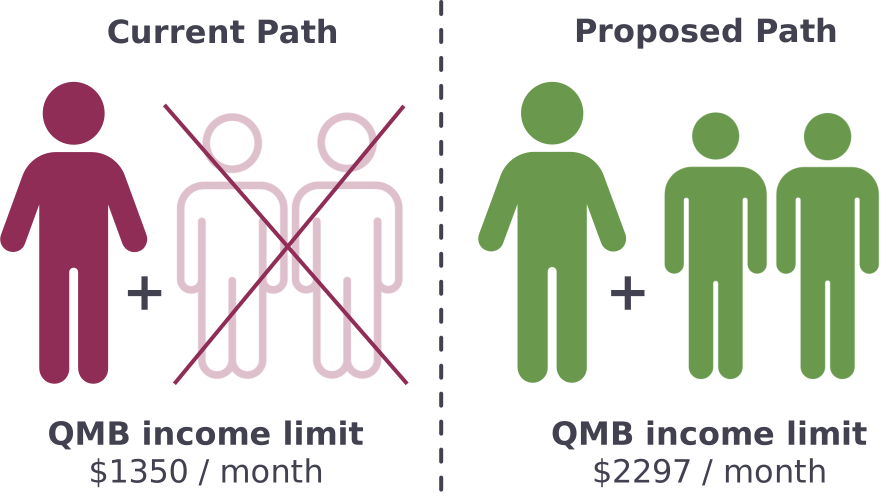
It varies based on the number of dependents involved, but here’s an example for an MSP applicant raising two dependent children in 2026:
- Qualified Medicare Beneficiary income limit based on family size of one (status quo in many states): $1,350/month
- Qualified Medicare Beneficiary income limit based on family size of three (i.e., counting two dependent children): $2,297/month91
We are not aware of a comprehensive data source for Medicare beneficiaries supporting dependents, although federal data provide a sense of scope:
- In 2023, about 2.4 million children in the United States were raised by grandparents, other relatives, or close family friends because their parents were unable to care for them. These families are more likely to experience poverty than other families.92
- An estimated 1 million adults with intellectual or developmental disabilities live with aging caregivers.93
- In 2021, more than two million grandparents were raising their grandchildren across the U.S. with variation across states.94 More than eight in ten of these grandparents had been doing so for at least a year, and nearly half of them had done so for at least five years. Only a fraction of grandparents are Medicare-eligible, but these data sources likely miss other circumstances in which Medicare beneficiaries support dependents.
States only count the income of a spouse or the income of a parent if the applicant is a child under 21, blind or disabled—not other relatives in the calculation.95
This is a policy decision for each state. Our model legislation applies to the QMB, SLMB, and QI eligibility groups, but a state can choose to apply the policy to other Medicaid eligibility groups. Applying the change only to the MSP eligibility groups costs less than applying to additional Medicaid eligibility groups but benefits fewer families and creates inconsistency across eligibility groups.
The change would likely require short-term policy and operational investments to update eligibility systems, including amending the State Medicaid Plan and updating manuals and related rules and guidance.
90 See SSA, “Understanding the Extra Help with Your Medicare Prescription Drug Plan,” January 2026, https://www.ssa.gov/pubs/EN-05-10508.pdf.
91 Each figure derived from tables, dividing by 12 and adding the standard $20/month income disregard, at “2026 Poverty Guidelines: 48 Contiguous States (All states except Alaska and Hawaii).”
92 Relatives Raising Children: Federal Support Helps, but Challenges Persist, GAO-26-107658 (U.S. Government Accountability Office, 2025), https://www.gao.gov/assets/gao-26-107658.pdf.
93 G. T. Fujiura, in Structure of Intellectual and Developmental Disabilities Households in the United States: Demographics of the Family in 2010, AAIDD 136th Annual Meeting, Charlotte, NC, 2012; Chuck Marr et al., Future Stimulus Should Include Immigrants and Dependents Previously Left Out, Mandate Automatic Payments (Center on Budget and Policy Priorities, 2020), https://www.cbpp.org/sites/default/files/atoms/files/5-6-20econ.pdf.
94 “Grandchildren Being Raised by Grandparents,” U.S. Department of Labor, https://www.dol.gov/agencies/wb/topics/grandparents-raising-grandkids; “GrandFacts: Fact Sheets,” Grandfamilies & Kinship Support Network, https://www.gksnetwork.org/grandfacts-fact-sheets.
95 See CMS, “Streamlining Medicaid; Medicare Savings Program Eligibility Determination and Enrollment,” Federal Register, Vol. 88, No. 182 (September 21, 2023): 65230, 65248, https://www.federalregister.gov/documents/2023/09/21/2023-20382/streamlining-medicaid-medicare-savings-program-eligibility-determination-and-enrollment. (“Regarding the concern about the deeming to MSP applicants or enrollees the income of relatives or dependents, we note that preexisting non-MAGI deeming rules, under section 1902(a)(17)(D) of the Act and §435.602(a)(2)(i), prohibit states from deeming to an applicant the income or resources of anyone who is not the spouse or parent of that individual. Thus, although the proposal to use the definition of ‘‘family size’’ under §423.772 to determine MSP-related eligibility may increase the family size of MSP applicants and enrollees, it will not expand the individuals whose income and/or resources may be deemed available to an MSP applicant or enrollee, as the non-MAGI deeming rule described in section 1902(a)(17)(D) of the Act and §435.602(a)(2)(i) continues to apply.”); section 1902(a)(17(D) of the Social Security Act; 42 CFR 435.602(a)(2)(i).
Technical input, corrections, and implementation insights related to this policy set are welcome.
Provide FeedbackRelated Policies
Eliminate the Asset Test
Many older adults and people with disabilities skip medical care and struggle financially because of high Medicare premiums and cost sharing. By leveraging the Medicare Savings Programs, states can ease the financial strain of Medicare. However, confusing and time-consuming asset verification requirements delay or prevent many eligible individuals from enrolling.
Open for
Comment
Comment
Flatten the Benefit Cliff from Medicaid to Medicare
Enrolling in Medicare results in many people losing Medicaid and facing much higher out-of-pocket costs. These costs amount to a financial shock—a problem known as the “Medicare cliff.”
Open for
Comment
Comment
Simplify Eligibility by Disregarding the Value of Non-Liquid Assets
The model state legislation below would simplify eligibility for the Medicare Savings Programs (MSPs) by disregarding the value of non-liquid assets—such as farm equipment or land separate from an individual’s primary residence—as permitted by section 1902(r)(2) of the Social Security Act.
Open for
Comment
Comment